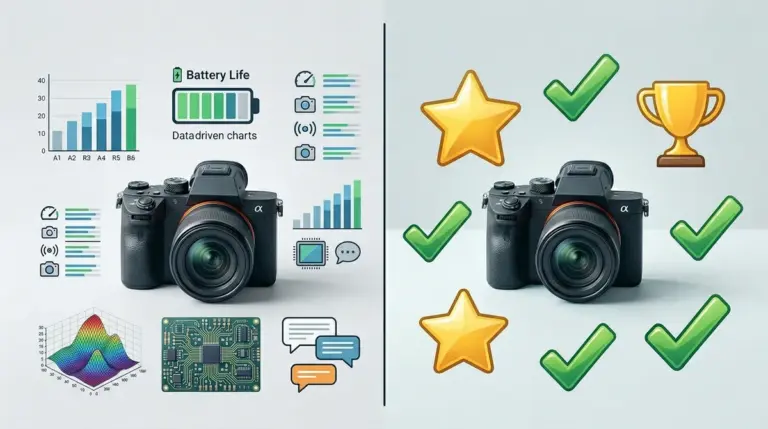


A buyer weighing a $2,000 mirrorless camera has entirely different information requirements than someone purchasing a $15 smartphone case. The former needs to see the autofocus speed in low light; the latter just needs to know if the cutouts align with the buttons. This divergence in buyer intent is why the debate between video and written reviews is a false dichotomy. They are not interchangeable formats; they are distinct tools serving different stages of the research cycle.
The Information Density of Written Reviews
Written reviews remain the primary tool for high-intent buyers who need to compare technical specifications or find specific answers quickly. Text allows for non-linear consumption. A user can hit CTRL+F to find "battery life" or "warranty" in seconds, whereas a video requires scrubbing through a timeline, which is a high-friction activity for a busy professional.
Best for: Technical comparisons, software documentation, B2B procurement, and SEO-driven research.
- Searchability: Written content is indexed more granularly by search engines, allowing long-tail queries to land users directly on the relevant paragraph.
- Comparison Clarity: Tables and bulleted lists allow for side-by-side spec comparisons that are difficult to visualize in a moving video.
- Updateability: If a software patch changes a feature, a written review can be edited in minutes. A video review remains frozen in time, often becoming obsolete within months.
Sensory Verification and the Video Experience
Video reviews dominate when the product’s value is tied to aesthetics, ergonomics, or performance that must be heard or seen to be believed. You cannot describe the "clickiness" of a mechanical keyboard or the "smoothness" of a gimbal’s stabilization as effectively as you can show it. Video builds a level of visceral trust that text cannot replicate because it is harder to fake a physical demonstration than it is to write a persuasive paragraph.
Best for: Consumer electronics, fashion, automotive, and physical hardware.
Pro Tip: When producing video reviews, always include timestamped chapters. Data shows that users are 40% more likely to engage with a video if they can skip directly to the "Performance" or "Verdict" sections, mimicking the scanning behavior of written text.
The Role of "Vibe" and Brand Personality
Video creates an emotional bridge. For agencies and influencers, the "vibe" of the reviewer—their tone of voice, their setting, and their transparency—acts as a proxy for the product's reliability. If a reviewer shows a product failing on camera, the authenticity of that moment carries more weight than a written "Cons" list. This is why YouTube has become the second-largest search engine; it is a platform built on the human need for social proof.
How Format Dictates User Intent
The choice between reading and watching often depends on where the buyer is in the funnel. Early-stage discovery often happens via video (the "unboxing" or "top 5" stage). Middle-stage evaluation, where the buyer is narrowing down two specific models, often moves to written reviews for deep-dive technical data. Finally, the "buy" decision is frequently validated by a quick return to a video to see the product in a real-world environment one last time.
The "Scan vs. Lean-Back" Behavior
Written reviews cater to "active" seekers—people who are working toward a decision and need data points to justify a purchase. Video reviews cater to "passive" or "lean-back" consumers who are in the discovery phase. If your site only offers one format, you are likely ignoring half of the psychological journey your customer is taking.
Technical SEO and Visibility Differences
From a commercial perspective, written reviews provide the "meat" for Google’s traditional search results. They allow for Schema markup (Review Snippets), which generates those crucial gold stars in the SERPs. These stars directly correlate with higher Click-Through Rates (CTR).
Video reviews, however, earn real estate in the Video Carousel and on YouTube. A video can often rank for a high-competition keyword faster than a new blog post because the competition for "video intent" keywords is sometimes lower than the competition for "text intent" keywords. For a brand, having both ensures you own the "above the fold" real estate on both Google Search and YouTube.
Optimizing Your Review Strategy for Maximum Conversion
To maximize conversion, you must match the format to the product's complexity. A complex SaaS platform requires a written guide with screenshots for troubleshooting, but it also needs a "walkthrough" video to show the UI in motion. A pair of hiking boots needs a written durability report after 500 miles, but it also needs a video to show how the material flexes and how the colors look in natural sunlight.
Strategic Implementation Checklist:
- Include a "TL;DR" (Too Long; Didn't Read) summary at the top of written reviews for the fastest scanning.
- Embed a video summary within the written article to increase dwell time—a key ranking signal.
- Use written transcripts or detailed captions for videos to ensure the content is accessible and searchable by bots.
- Ensure all "Pros and Cons" are listed in text, even if they are discussed in the video, to capture "comparison" search traffic.
Execute a Multi-Format Review Strategy
The most successful publishers do not choose between video and text; they integrate them. Start by identifying your highest-traffic written reviews and supplement them with a 3-minute video summary. Conversely, take your most popular video reviews and transcribe them into structured, SEO-optimized articles. By serving both the "scanner" and the "watcher," you reduce bounce rates and provide the specific type of proof each individual buyer needs to click "buy."
Frequently Asked Questions
Which format has a higher conversion rate?
Written reviews typically lead to higher direct conversions for technical or B2B products because they facilitate the final "spec-check." Video reviews often have higher conversion rates for lifestyle and impulse-buy consumer goods where visual appeal is the primary driver.
Should I prioritize video or written content for a new site?
Prioritize written content first. It is faster to produce, easier to update, and provides the foundational SEO needed to get indexed. Once you have a baseline of traffic, use video to increase dwell time and build brand authority.
How long should a video review be compared to a written one?
A video review should ideally be between 5 and 12 minutes, depending on the product complexity. A written review should be as long as necessary to cover all technical details, typically ranging from 1,000 to 2,500 words for high-ticket items.