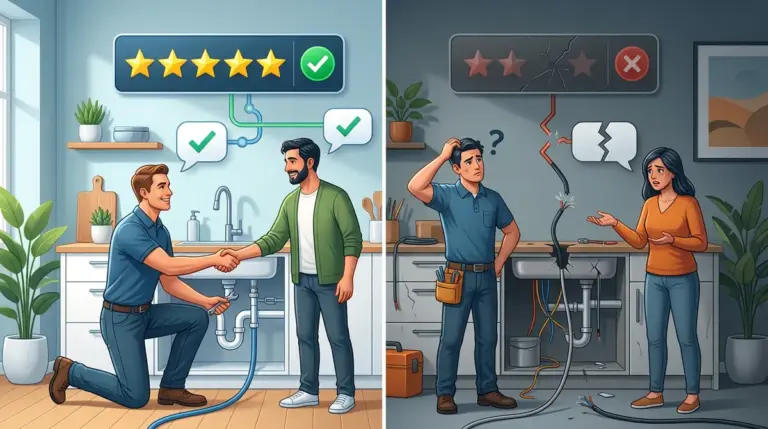
For a local service business—whether it is a plumbing outfit in Chicago or a boutique law firm in London—the choice between paid search ads and organic review management is often framed as a "both/and" strategy. However, the data suggests a stark hierarchy. While Google Ads can buy a position at the top of the SERP, they cannot buy the consumer confidence required to close a high-ticket service lead. In local markets, reviews act as a trust proxy that high-visibility ads simply cannot replicate. For service providers where the "cost of failure" is high (e.g., a burst pipe or a legal dispute), a 4.8-star rating with 200 reviews consistently outperforms a "Sponsored" tag, regardless of the ad budget.
The Local Pack Dominance: Why Ratings Trump Bids
Google’s Local Pack (the "Map Pack") is the primary real estate for local service queries. While Google has integrated ads into this section, the organic results beneath the map are prioritized by users who have developed "ad blindness." A study of click-through rates (CTR) shows that the top organic local result often captures significantly more traffic than the sponsored result above it, provided the organic listing has a superior review profile.
Best for: High-competition niches like HVAC, roofing, and dentistry where trust is the primary barrier to entry.
The algorithm for the Local Pack considers three primary pillars: relevance, distance, and prominence. Reviews fall squarely into "prominence." Google does not just look at your average star rating; it analyzes review velocity (how often you get new reviews), review diversity (reviews across different platforms), and the presence of keywords within the review text. An ad can jump the queue on distance and relevance, but it cannot simulate the prominence signals that a decade of customer feedback provides.
The Impact of Review Velocity on Local Rankings
A static profile with 50 five-star reviews from three years ago is a liability. Google’s local algorithm favors "freshness." If your competitor is receiving three new reviews a week and you are receiving one a month, your ad spend will have to work twice as hard to maintain the same lead volume. High review velocity signals to Google that a business is active and currently reliable, which directly influences organic visibility without the recurring cost-per-click (CPC) of an ad campaign.
Conversion Rate Optimization (CRO) and the Trust Gap
Paid ads are a traffic source, not a conversion tool. If a user clicks a "Sponsored" link and lands on a page with no social proof, the bounce rate spikes. Conversely, businesses that prioritize their review profile see a "halo effect" on their paid traffic. When a prospect sees a high-rated business in the organic map pack and then sees a retargeting ad from that same business, the conversion probability increases by over 40%.
For service businesses, the "trust gap" is the distance between a stranger seeing your name and that stranger inviting you into their home. Ads represent a business’s self-assessment—which consumers inherently distrust. Reviews represent the peer-to-peer assessment, which carries the weight of a personal recommendation. In a direct comparison, a $50 CPC for a "Plumber near me" keyword is wasted if the landing page doesn't immediately mirror the high-star sentiment found on Google Business Profiles.
Pro Tip: Do not just collect reviews; respond to the negative ones with a focus on "Reviewer Intent." When you resolve a 1-star complaint publicly and professionally, you aren't just talking to the disgruntled customer; you are marketing to every future prospect who is looking for a reason to trust you when things go wrong.
Quantifying the ROI: Reviews vs. PPC
To understand the commercial value of reviews, you must look at the Customer Acquisition Cost (CAC) over a 12-month period. PPC is a linear expense: if you stop paying, the leads stop. Review management is an exponential asset: the more reviews you accumulate, the higher your organic rank climbs, and the lower your reliance on paid media becomes.
- Review Sentiment Analysis: Google uses Natural Language Processing (NLP) to understand if customers mention specific services (e.g., "emergency boiler repair"). This helps you rank for "long-tail" service keywords that are too expensive to bid on in Ads.
- Click-Through Rate (CTR) Boost: Profiles with 5 stars receive approximately 25% more clicks than those with 3 stars, even if the 3-star business is in a higher position.
- Google Guarantee Integration: For Local Services Ads (LSAs), your review score is the primary factor in your "background checked" ranking. You cannot simply "outbid" a poor reputation in the LSA auction.
The Zero-Click Search Reality
More than 50% of Google searches now end without a click to a website. Users find the phone number, address, and reputation directly on the SERP. In this environment, your Google Business Profile (GBP) is your actual homepage. If your GBP is fueled by a robust review pipeline, you capture the lead without the user ever seeing your paid landing page. Ads are designed to drive traffic to a site; reviews are designed to drive calls to a business. For local services, the call is the only metric that matters.
The Filter Effect of Negative Reviews
A perfect 5.0 rating can actually be a deterrent. Modern consumers are savvy; they look for a "natural" distribution of reviews. A business with a 4.8 rating and 300 reviews is often viewed as more authentic than one with a 5.0 and 10 reviews. This authenticity reduces the "friction to call." While an ad tries to present a flawless image, a healthy review profile presents a realistic, high-performing business, which is far more persuasive to a homeowner in a crisis.
Operationalizing Your Reputation Management
To move beyond a reliance on expensive ad auctions, service businesses must treat review acquisition as a core operational process rather than a marketing afterthought. This requires a shift from "asking for a favor" to "closing the loop" on the service experience.
Start by identifying the "Peak-End" moment of your service—the point where the customer is most satisfied (usually right when the job is completed and the problem is solved). Implementing an automated SMS request at this exact moment will yield a 3x higher response rate than an email sent two days later. By building this "Review Flywheel," you create a self-sustaining lead generation engine that eventually lowers your required ad spend to zero for your primary service keywords.
Frequently Asked Questions
Do reviews affect my Google Ads performance?
Yes. Your Google Business Profile rating can impact your Local Services Ads (LSA) ranking and your Ad Rank in traditional search through location extensions. Higher ratings lead to higher CTRs, which can improve your Quality Score and lower your cost-per-click.
How many reviews do I need to beat a competitor who is using ads?
There is no "magic number," but you should aim for 15-20% more reviews than your top three organic competitors. More importantly, your "Review Velocity" (the number of new reviews per month) should match or exceed theirs to signal current relevance to Google’s algorithm.
Can I just use ads to hide a bad reputation?
No. In fact, running ads for a business with a poor review profile is a fast way to burn budget. Users will see the ad, check the reviews in the Map Pack or on third-party sites, and then choose a competitor. Ads amplify your current reputation; they do not replace it.