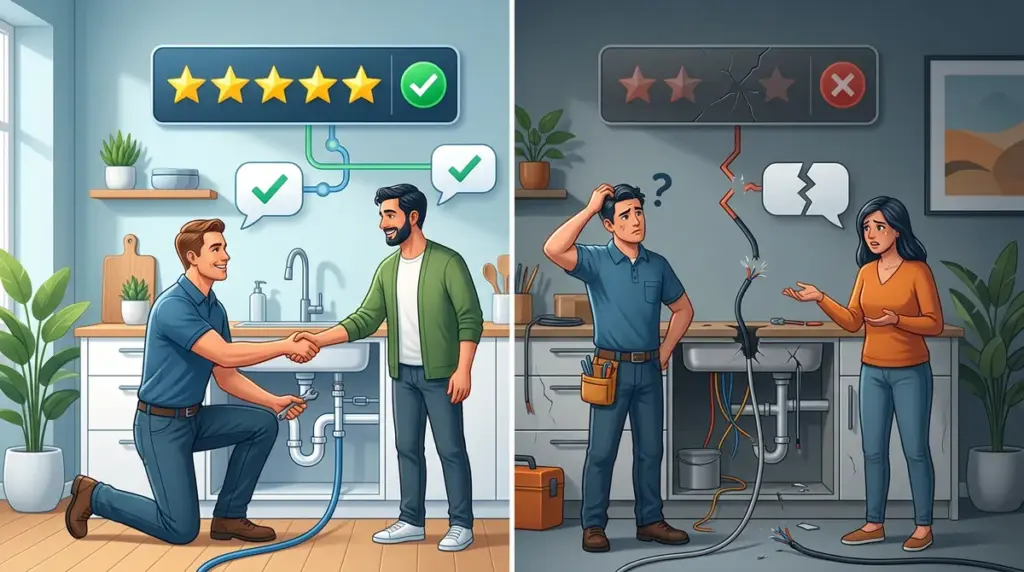
In the home services sector—covering everything from emergency plumbing to multi-week roof replacements—a review is rarely a critique of the technical work itself. Most homeowners lack the expertise to judge the torque on a pipe or the flashing on a chimney. Instead, review sentiment acts as a proxy for operational reliability and communication efficiency. When a business loses a potential lead to a competitor with a lower star rating but a higher volume of recent, detailed feedback, the cause is usually a failure to bridge the gap between "doing the job" and "managing the client."
The Arrival Window as a Trust Metric
Reliability in home services is frequently reduced to a single variable: punctuality. Analysis of negative reviews in the HVAC and electrical sectors shows that "no-shows" and "late arrivals without notice" account for over 60% of one-star ratings. For a service provider, a delay might be caused by a complex job earlier in the day, but for the customer, it represents a breach of contract.
Best for Service Managers: Use automated SMS dispatch notifications. Reviews that mention "I knew exactly when the tech was coming because of the text alerts" correlate with 4.8-star averages, even when the actual arrival was outside the original window.
When a technician arrives late without a proactive update, the customer begins the interaction in a defensive state. This skepticism often leads to closer scrutiny of the invoice, turning a scheduling error into a pricing dispute. Reliability is not just about being on time; it is about the predictability of the service experience.
Quantifying the Cost of Ghosting
"Ghosting"—the failure to return a quote or follow up on a diagnostic visit—is a silent killer of conversion rates. In highly competitive local markets, a lead has a half-life of roughly five minutes. If a consumer leaves a review stating, "I called three times and never got a callback," it signals to every future lead that the company is overextended or disorganized. This specific type of feedback is more damaging than a complaint about a high price, as it suggests the business is incapable of basic professional courtesy.
Decoding Communication Gaps in Project Scoping
Communication gaps typically manifest during the transition from the initial estimate to the final bill. Homeowners often use reviews to vent about "hidden fees" or "unforeseen costs," which are usually the result of a failure to set expectations during the scoping phase. A transparent communication loop requires documenting potential variables before the work begins.
- The Quote Gap: Providing a verbal estimate that differs from the digital invoice.
- The Scope Gap: Failing to explain that "repair" does not include "cosmetic restoration" (e.g., fixing a leak but leaving a hole in the drywall).
- The Timeline Gap: Promising a one-day turnaround when parts are backordered.
Warning: Avoid "canned" responses to reviews that mention specific communication failures. Using a generic "We strive for excellence" template in response to a detailed complaint about a missing quote confirms to the reader that the business is not listening.
The Role of Technical Literacy in Reviews
Communication gaps often stem from a mismatch in technical literacy. A technician might explain a "cracked heat exchanger" in jargon that the homeowner doesn't grasp. When the homeowner writes a review, they describe the interaction as "pushy" or "trying to upsell." Reliability in this context means the ability to translate technical necessity into consumer value. Reviews that praise a technician for "taking the time to show me the problem on camera" are high-value assets for local SEO, as they signal authority and trustworthiness to Google’s sentiment algorithms.
How Review Sentiment Influences Local Pack Rankings
Google’s local search algorithm prioritizes "relevance, distance, and prominence." Prominence is heavily weighted by review count and score, but also by the specific keywords found within those reviews. If your business is consistently tagged with words like "reliable," "on-time," and "professional," you are more likely to appear in the Local Pack for high-intent queries like "plumber near me" or "emergency AC repair."
Best for SEO Agencies: Monitor the "People also ask" section for home service queries. Often, these questions reflect the anxieties found in negative reviews (e.g., "How much should a service call cost?"). Addressing these anxieties in your review responses and on-site FAQ pages can improve click-through rates from the GMB profile.
A communication gap on the job site eventually becomes a data gap in your local SEO strategy. If customers are not mentioning your specific services (e.g., "tankless water heater installation") because the technician didn't clearly communicate the service being performed, you lose the semantic weight needed to rank for those specific long-tail keywords.
Operationalizing Feedback to Close the Gap
To move from reactive damage control to proactive brand building, home service businesses must treat reviews as raw operational data. If three reviews in a month mention that the "office staff was rude," it is not a customer service anomaly; it is a training requirement. Reliability is a byproduct of systems, not just individual effort.
Implementing a "closing loop" process ensures that communication gaps are caught before they reach a public forum. This involves a post-job follow-up call or text within 24 hours. By asking, "Did the technician explain the repairs to your satisfaction?" you provide a private channel for venting, which often prevents a negative public review while providing the specific details needed to improve service delivery.
Audit Your Customer Touchpoints
To improve your reliability metrics and bridge communication gaps, execute the following audit of your current customer journey. This moves the focus from chasing stars to fixing the underlying service engine.
First, analyze your last 20 negative or neutral reviews. Categorize them into "Technical Failure," "Punctuality," or "Communication." Most firms find that over 70% fall into the latter two. Second, review your automated messaging. If your "appointment confirmed" email doesn't include a photo of the technician or a clear explanation of the service fee, you are missing an opportunity to build trust before the door opens. Finally, ensure your field software allows technicians to upload photos of completed work directly to the customer portal; visual evidence is the ultimate bridge for communication gaps.
Frequently Asked Questions
How do reviews affect my ability to charge premium prices?
Reliability is a premium commodity. Customers are willing to pay 15-20% more for a service provider with a proven track record of showing up on time and communicating clearly. Reviews act as the social proof that justifies a higher estimate compared to a "trunk slammer" with no online presence.
What is the most effective way to handle a review about a communication breakdown?
Acknowledge the specific point of failure. Instead of saying "Sorry for the experience," say "I see that we failed to send the follow-up quote on Tuesday as promised." Offer a direct line to a manager. This demonstrates accountability to anyone else reading the review.
Can positive reviews improve my technicians' morale?
Yes. Sharing specific, name-drop reviews during team meetings reinforces the value of "soft skills" like communication. When a technician sees that their clarity and politeness resulted in a 5-star public shout-out, they are more likely to prioritize those behaviors over just finishing the job quickly.