A 4.8-star rating used to be a conversion engine; now, it is often a red flag for savvy buyers. As review platforms have become saturated with incentivized feedback, bot-generated praise, and "review-gated" scores, the average consumer has developed a sophisticated filter. They are not ignoring ratings entirely, but they are ignoring the aggregate score in favor of more granular, recent, and critical data points. For marketers and site owners, this shift means that a high volume of generic five-star ratings is no longer a competitive advantage—it is a baseline that carries diminishing returns.
The Mathematical Skepticism of Modern Shoppers
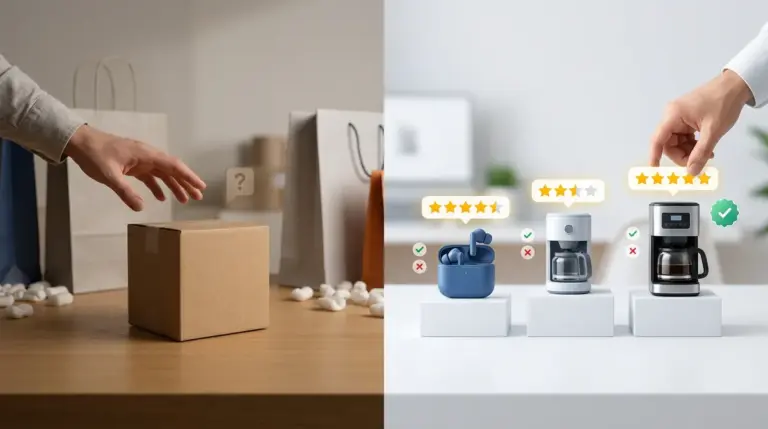
Consumer trust does not scale linearly with star ratings. Data from the Spiegel Research Center indicates that the likelihood of purchase peaks when a product has a star rating between 4.2 and 4.5. Once a rating hits a perfect 5.0, purchase intent actually drops. Consumers perceive a perfect score as "too good to be true," suspecting either a low sample size or deliberate manipulation of the feedback loop.
Best for: E-commerce managers and local SEO leads who need to justify why they shouldn't delete every three-star review. A mix of ratings proves authenticity and provides a realistic expectation of the product or service.
Review fatigue is driven by the homogenization of social proof. When every SaaS tool, local plumber, and Amazon gadget displays a 4.7-star badge, the badge loses its signaling power. Buyers are shifting their focus to the "Review Gap"—the discrepancy between the star rating and the actual content of the written feedback. If a product has 500 five-star ratings but only 10 written reviews, the fatigue manifests as immediate bounce behavior.
The Rise of Negative-First Reading Habits
Review fatigue has birthed a specific behavioral pattern: the "Negative-First" filter. Instead of reading the top-rated reviews curated by the platform, users are increasingly sorting by "Most Recent" or "Lowest Rated." They are looking for the "worst-case scenario" of their purchase. They want to know what happens when things go wrong, how the customer service team responds, and whether the product's flaws are deal-breakers or minor inconveniences.
The Decay of Review Recency
The shelf life of a review is shorter than ever. A glowing review from 2022 is functionally irrelevant to a buyer in 2024. Industry benchmarks suggest that 85% of consumers believe reviews older than three months are no longer relevant. This creates a "hamster wheel" effect for brands: you cannot rely on a historical bank of positive feedback; you must maintain a consistent, fresh stream of incoming data to remain credible.
Warning: Automated review solicitation emails that trigger immediately after purchase often result in "shallow" reviews. To combat fatigue, delay your request until the customer has had sufficient time to realize the product's value. A "Verified Purchase" badge is worthless if the review text is just three words long.
The Impact of AI-Generated Feedback on Trust
The proliferation of Large Language Models (LLMs) has made it easier for unscrupulous actors to flood platforms with realistic-sounding praise. This has accelerated review fatigue by forcing consumers to look for "human markers" in feedback. Shoppers are now looking for specific, idiosyncratic details that an AI is unlikely to invent, such as specific use cases, photos of the packaging, or mentions of a specific staff member by name.
For brands, this means that "perfect" grammar and generic praise ("Great product, highly recommend!") are now viewed with suspicion. Raw, slightly messy, and highly specific feedback is the new gold standard for conversion.
Operationalizing Authenticity to Combat Fatigue
To overcome the consumer's tendency to skim past ratings, brands must change how they display and solicit social proof. The goal is to move from "aggregate scores" to "searchable attributes."
- Attribute-Based Filtering: Allow users to filter reviews by specific criteria (e.g., "Fit," "Battery Life," "Ease of Setup"). This bypasses the generic star rating and gives the buyer the specific data point they need.
- UGC Integration: Reviews accompanied by customer-taken photos or videos have a 15-25% higher conversion lift than text-only reviews. They provide visual proof that counters the "fake review" narrative.
- Public Conflict Resolution: Responding to a negative review within 24 hours is more impactful than gaining five new positive reviews. It demonstrates operational reliability, which is what the fatigued consumer is actually looking for.
- Verified Customer Attributes: Displaying the reviewer's context (e.g., "Verified Buyer," "User for 2+ years," "Professional Photographer") adds a layer of authority that generic ratings lack.
Auditing Your Review Strategy for Higher Conversion
If your conversion rates are stalling despite high star ratings, your audience is likely suffering from review fatigue. You need to audit your feedback loop to ensure it provides more than just a numerical score. Start by analyzing your "Review Velocity"—the rate at which new reviews are posted. If your velocity has dropped, your older reviews are likely dragging down your conversion rate, regardless of how high the score is.
Next, look at your review-to-text ratio. If you have a high volume of ratings without written content, your profile looks manufactured. Focus your solicitation efforts on "long-form" feedback. Incentivize detail, not just positivity. Ask customers specific questions in your follow-up emails, such as "What was the one thing that surprised you about the setup process?" This prompts the kind of specific, concrete feedback that cuts through the noise of generic five-star fatigue.
FAQ
How many reviews do I need before the "fatigue" effect settles in?
Fatigue isn't about the total number; it's about the lack of diversity. A product with 50 reviews that all look the same is more prone to being ignored than a product with 5,000 reviews that include photos, videos, and varying perspectives. However, once you pass 50-100 reviews, the marginal utility of each new review shifts from "building trust" to "maintaining recency."
Does a 4.0 rating perform better than a 5.0?
Statistically, yes. A 4.2 to 4.5 rating is generally the most "trustworthy" range for consumers. A 5.0 rating often triggers skepticism unless the review count is very low (under 10), in which case it is viewed as "unproven."
What is the most important factor in a review in 2024?
Recency and specificity. A review from the last 30 days that mentions a specific feature or problem-solving scenario is worth more than a year's worth of generic five-star "Great!" comments. Consumers want to see that your business is performing well *right now*.
Should I delete or hide negative reviews to improve my score?
No. Deleting negative reviews is a violation of most platform terms (like Google and Trustpilot) and can lead to "Review Gating" penalties. More importantly, negative reviews provide the contrast necessary for your positive reviews to look authentic. The key is how you respond to them publicly.