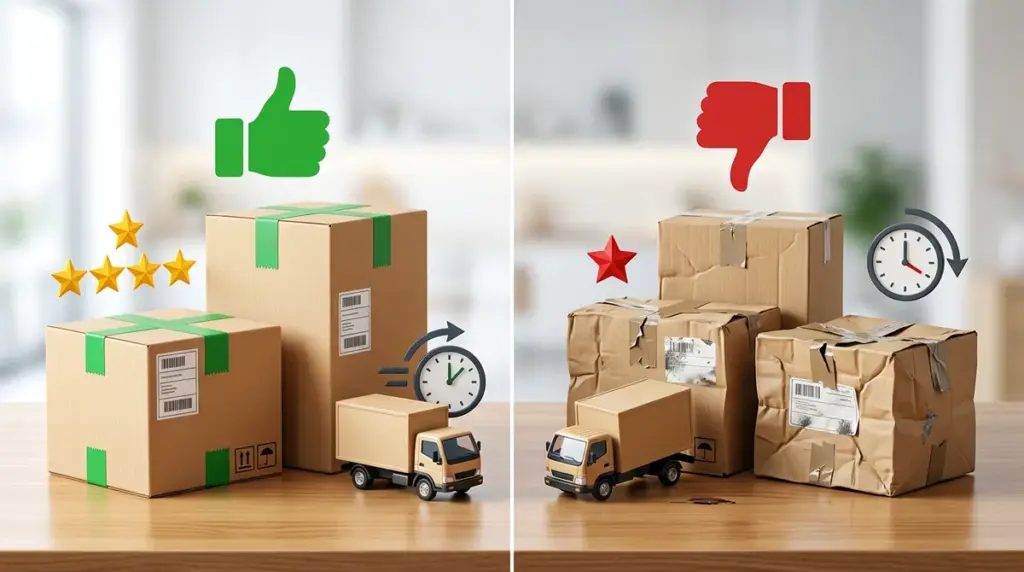
For most e-commerce brands, the marketing budget is focused heavily on the top of the funnel—customer acquisition cost (CAC) and conversion rate optimization (CRO). However, an analysis of thousands of customer reviews across Shopify, Amazon, and big-box retailers reveals that brand loyalty is rarely won on the product page. It is won or lost in the "last mile." Shipping and fulfillment are no longer back-end logistics concerns; they are the primary drivers of customer sentiment and repeat purchase behavior.
When a customer leaves a review, they are documenting the gap between your brand promise and their physical reality. By categorizing these reviews, we can identify specific fulfillment benchmarks that separate high-growth brands from those struggling with high churn. This guide breaks down the critical logistics data points hidden within customer feedback and how to use them to optimize your operations.
The Reliability Gap: Accuracy Over Raw Speed
The "Amazon Prime effect" has conditioned consumers to expect fast shipping, but review data suggests that reliability is actually more valuable than raw speed. A customer is generally more satisfied with a three-day delivery that arrives on time than a "next-day" delivery that arrives in 48 hours. Negative reviews frequently cite missed windows rather than long lead times.
Key Insight: Fulfillment transparency reduces "Where Is My Order" (WISMO) inquiries and prevents one-star reviews. If your logistics chain cannot guarantee 24-hour shipping, it is commercially safer to offer a realistic 3-to-5-day window with 100% accuracy.
- Predictive Delivery Dates: Brands using AI-driven delivery estimates on the product page see a 12% increase in conversion over those offering vague "standard shipping" labels.
- Buffer Times: High-performing stores often add a 24-hour buffer to their public-facing delivery estimates to ensure they consistently "under-promise and over-deliver."
- Carrier Performance: Reviews often name-drop specific carriers (e.g., FedEx vs. USPS). If a specific region shows a pattern of negative reviews tied to a carrier, it is an operational signal to switch providers for those zip codes.
Communication as a Fulfillment Feature
Fulfillment does not end when the package leaves the warehouse. Customer reviews reveal that the "black hole" period—the time between the order confirmation and the delivery—is the highest point of anxiety. Brands that fail to provide proactive updates are penalized in the review section, even if the product itself is perfect.
Effective communication strategies identified in five-star reviews include:
1. Real-Time Tracking Pages: Instead of sending customers to a carrier’s clunky tracking site, top brands host the tracking data on their own domain. This keeps the brand experience consistent and allows for cross-selling opportunities.
2. Milestone Notifications: SMS or email updates for "Out for Delivery" and "Delivered" significantly reduce the likelihood of package theft complaints, as customers can retrieve items immediately.
3. Proactive Delay Alerts: A review that says "The item was late, but they told me before I had to ask" is almost always more positive than one where the customer had to hunt for information. Proactive communication converts a logistics failure into a customer service win.
Pro Tip: Audit your "Order Delivered" automated emails. If you ask for a review within minutes of the delivery scan, you risk capturing the customer's frustration if the package was misdelivered or damaged. Wait 24 to 48 hours to ensure the customer has actually unboxed and tested the product.
Packaging: The Physical Manifestation of Brand Value
In a digital-first world, the shipping box is the only physical touchpoint a customer has with your brand. Review sentiment regarding packaging usually falls into two categories: protection and sustainability.
Damage Rates and Structural Integrity: Nothing kills a customer's lifetime value (LTV) faster than a "Dead on Arrival" (DOA) product. Reviews mentioning "leaking bottles," "crushed boxes," or "broken parts" are direct indicators that your dunnage (packing material) is insufficient for the carrier's sorting equipment. High-end electronics and fragile goods require double-walled corrugated boxes, yet many brands cut costs here, leading to a 5-10% return rate that erodes all profit margins.
The Sustainability Mandate: Modern consumers are increasingly vocal about "over-packaging." Reviews often criticize brands for shipping small items in oversized boxes filled with non-recyclable plastic. Transitioning to right-sized packaging and biodegradable mailers isn't just an environmental choice; it’s a strategy to avoid the "wasteful brand" label in public feedback.
The Returns Friction Point
Fulfillment expectations extend to the return process. A significant portion of "neutral" 3-star reviews are written by customers who liked the product but hated the return experience. If a customer has to print a label, pay for shipping, and wait 14 days for a refund, they are unlikely to shop with that brand again.
Best for Retention: Implementing a "printerless" return system (such as QR codes at drop-off locations) and offering "instant credit" for exchanges. This keeps the capital within your ecosystem and prevents the customer from moving to a competitor after a return.
Operationalizing Review Data for Logistics Growth
To turn reviews into an operational roadmap, you must move beyond reading individual comments and start quantifying the data. Use sentiment analysis to tag reviews with keywords like "late," "damaged," "slow," or "easy return."
If "damaged" appears in more than 2% of reviews, your warehouse team needs to re-evaluate the dunnage protocol. If "late" is a recurring theme in a specific geographic region, your 3PL (Third-Party Logistics) provider may need to move inventory to a closer distribution center. By treating reviews as a diagnostic tool for your supply chain, you move from reactive firefighting to proactive optimization.
E-commerce Fulfillment FAQ
How much does shipping speed actually impact review scores?
Speed is secondary to accuracy. While 2-day shipping is a competitive advantage, 90% of negative shipping reviews focus on "missed expectations"—such as an item arriving after a promised date—rather than the length of the shipping window itself.
What is the most common logistics complaint in one-star reviews?
The most common complaint is "Lack of Communication." Customers are generally forgiving of delays if they are notified proactively. Frustration peaks when a customer has to reach out to support to find out where their paid-for product is located.
Does sustainable packaging actually improve customer ratings?
Yes, particularly in the beauty, apparel, and home goods sectors. Customers frequently mention "minimal waste" or "recyclable materials" as a positive highlight of their unboxing experience, which contributes to a higher overall brand perception.
Should I offer free shipping if it slows down delivery?
Data suggests that "Free but Slower" is often preferred over "Paid and Faster" for non-essential goods. However, you must clearly state the expected delivery date at checkout to manage expectations and prevent negative feedback regarding the transit time.