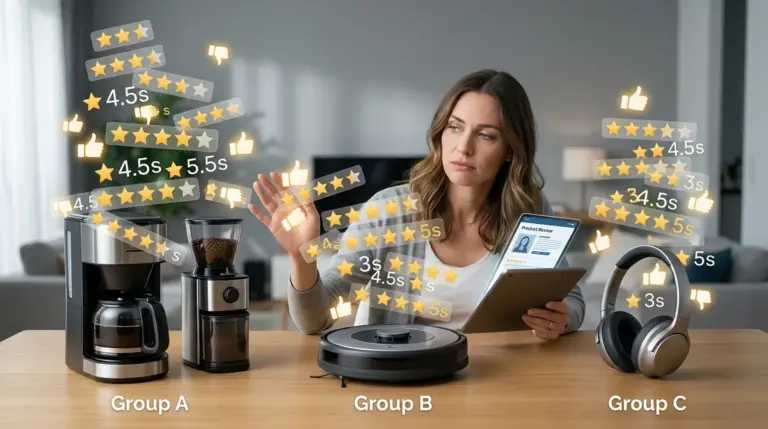
A 4.8-star rating on a major review platform is often the primary filter for software procurement, yet it frequently serves as a lagging indicator of actual performance. For SEO agencies and enterprise publishers, relying on an aggregate score is a high-risk strategy that ignores technical debt, shifting pricing models, and the "feature rot" that occurs when a legacy tool stops innovating. A high score can easily mask a platform that has become bloated, slow, or unsupported, provided they have enough historical momentum to dilute recent negative feedback.
The Mathematical Mirage of Lifetime Averages
The most significant flaw in star ratings is the lack of temporal weighting. A tool that was industry-leading in 2019 might have 2,000 five-star reviews from that era. If the company was acquired in 2023, slashed its support staff, and increased its API latency, the resulting wave of one-star reviews will barely budge the 4.8-star lifetime average. When evaluating software, the "All Time" score is a vanity metric; the "Last 6 Months" trend is the operational reality.
Best for identifying: Product stability and current engineering velocity.
To bypass this, look specifically for the delta between historical praise and recent complaints. If the 2024 reviews suddenly pivot from praising "intuitive UI" to complaining about "broken integrations" or "billing errors," the aggregate score is officially obsolete. You are buying the software as it exists today, not the version that earned its reputation five years ago.
Incentivized Sentiment and the Gift Card Economy
Review platforms frequently partner with SaaS vendors to run "review campaigns." In exchange for a $20 gift card, users are prompted to leave a review. This creates a specific type of bias: the "low-effort positive" review. These entries are usually three sentences long, lack technical detail, and almost always award five stars because the user feels a transactional obligation to the vendor.
- The "Generic Praise" Red Flag: Reviews that use phrases like "easy to use" or "great interface" without mentioning specific workflows or edge cases.
- The Missing "Cons" Section: In an incentivized review, the "What do you dislike?" section is often filled with "Nothing at all" or "The price could be lower," which offers zero utility to a professional buyer.
- The Timestamp Cluster: If a product receives 50 five-star reviews in a single week after three months of silence, you are looking at an incentivized campaign, not a sudden surge in user satisfaction.
Warning: Always filter by "Verified User" and "Most Recent." If the most detailed, high-utility reviews are buried under a mountain of one-sentence accolades, the vendor is likely "padding" their score to hide a recent drop in product quality or a controversial pricing hike.
The Persona Mismatch in Aggregate Scoring
A tool can be objectively excellent for a freelance blogger but functionally useless for a 50-person agency. Star ratings fail to segment by user complexity. A "five-star" SEO tool might earn that rating because it is cheap and simple for beginners, but for an enterprise user, the lack of SSO (Single Sign-On), granular permissioning, or bulk data export makes it a one-star solution.
Best for identifying: Scalability and workflow compatibility.
When reading reviews, ignore the stars and look for the reviewer’s context. A negative review from a "Head of SEO at a 500+ employee company" regarding API limitations is worth more than ten five-star reviews from "Small Business Owners" who only log in once a month. The aggregate score treats these votes as equal, but for your procurement process, they are not.
Detection of Review Gating and Selection Bias
Many companies employ "review gating," a practice where they use internal NPS (Net Promoter Score) surveys to identify happy customers. Only those who provide a 9 or 10 are then prompted with a direct link to a public review site. This creates an artificial floor for the star rating. The absence of mid-tier, three-star reviews is often a sign of a curated feedback loop rather than a perfect product.
A healthy product ecosystem should have a "long tail" of three and four-star reviews. These are typically the most honest assessments, detailing specific trade-offs—such as a tool having excellent data accuracy but a steep learning curve or a high price point. If a product only has five-star raves and one-star "it didn't work" rants, the middle ground of nuanced reality has been engineered out of the public view.
Technical Debt and Support Latency
Stars rarely reflect the quality of a company’s support infrastructure until it is too late. A platform might have a brilliant feature set, but if their median response time has slipped from two hours to two days, that won't show up in the headline rating for months. Sharp buyers look for keywords in the text: "outsourced support," "templated responses," or "ticket backlog."
Best for identifying: Long-term operational risk.
Technical debt is another "hidden" factor. A tool might look great on the surface, but if recent reviews mention frequent downtime, slow loading states, or "buggy" new releases, it indicates that the underlying codebase is struggling to scale. These are structural issues that a 4.5-star rating will not communicate until the platform experiences a major outage.
How to Conduct a High-Utility Review Audit
To move beyond the star rating, adopt a forensic approach to software evaluation. Stop looking at the average and start looking at the outliers. The goal is to find the "informed negative" review—the user who clearly understands the tool but has hit a specific, documented limitation that could impact your business.
Focus on the "Dislikes" section of four-star reviews. These users generally like the product enough to keep using it, which makes their criticisms more credible and less likely to be motivated by a single bad support interaction. They will tell you exactly where the product's "ceiling" is, allowing you to decide if your team will hit that ceiling in six months or six years.
Frequently Asked Questions
How many reviews are needed for a star rating to be statistically significant?
For SaaS products, volume is less important than diversity. A product with 30 reviews from verified enterprise users is more "significant" than a product with 500 reviews from anonymous accounts or small-scale hobbyists. Look for at least 15-20 reviews from users in your specific industry or company size to establish a baseline.
Why do some of the best tools have lower star ratings than mediocre ones?
Complex, high-end tools often have lower ratings because they have a steeper learning curve. A user who fails to configure a complex enterprise tool will leave a one-star review, whereas a simple, "thin" tool is easy to use and thus attracts easy five-star ratings. The "best" tool for a professional often requires more effort to master, which is reflected in a more polarized rating distribution. This makes it vital to understand what a five-star rating truly means beyond the simple number.
Should I trust reviews that are more than 12 months old?
Generally, no. In the SEO and marketing technology space, 12 months is an eternity. Features are deprecated, pricing tiers are restructured, and leadership changes. Any review older than a year should be treated as historical context rather than a reflection of the current user experience.
What is the most reliable way to spot a fake or incentivized review?
Look for "over-specification" of the brand name and a lack of specific pain points. Incentivized reviewers often repeat the product name multiple times for SEO purposes and use marketing-speak that sounds like it was lifted directly from the product's landing page. If a review sounds like a press release, it probably is one.