

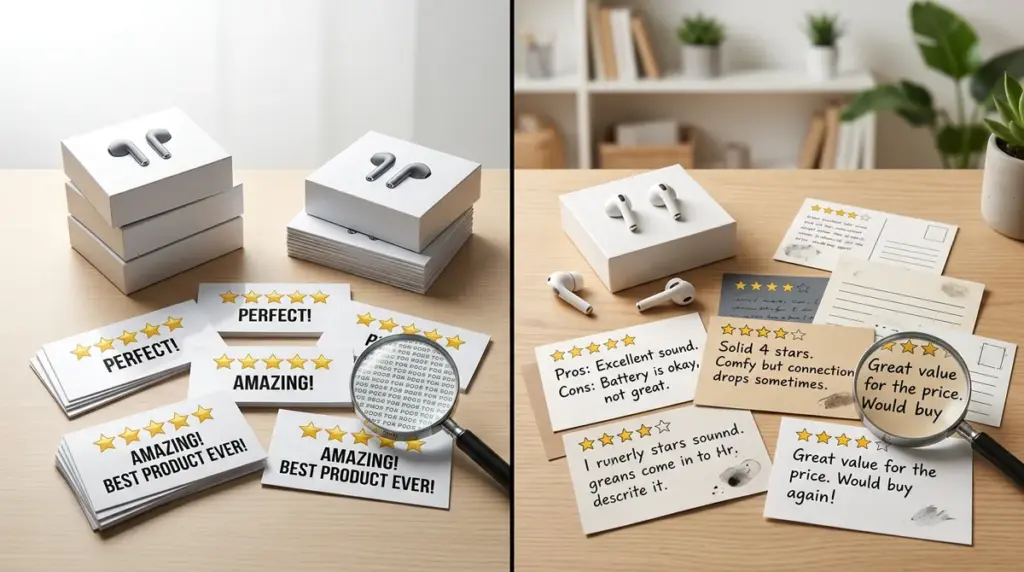
Fake reviews are a multi-billion dollar friction point in the digital economy. For a marketer or business owner, they represent more than just dishonest competition; they are data pollutants that skew conversion metrics and erode the integrity of the feedback loop. Spotting them isn't about intuition or "gut feelings." It requires a systematic look at linguistic patterns, metadata anomalies, and reviewer history. When you stop looking for "meanness" or "praise" and start looking for structural inconsistencies, the facade of a paid review campaign collapses quickly. These data pollutants that skew conversion metrics can make it difficult to distinguish between genuine feedback and outright fraud.
The Linguistic Fingerprints of Paid Reviews
Automated or low-cost human review farms operate on volume, not nuance. This creates specific linguistic markers that differ significantly from organic customer feedback. Real customers tend to focus on the "middle ground" of an experience—the logistics of delivery, a specific feature that worked, or a minor frustration. Fake reviews often oscillate between extreme poles of sentiment without providing the connective tissue of a real user story. These specific linguistic markers that differ significantly from organic customer feedback are often a giveaway of automated or AI-generated content.
Watch for Lexical Poverty: Fake reviews often lack specific nouns related to the product’s function. Instead of mentioning "the tactile response of the mechanical switches," a fake review will stick to generic adjectives like "amazing," "incredible," and "best ever." If the review could apply to a toaster just as easily as it applies to a SaaS platform, it is likely a template.
The "Scene-Setting" Red Flag: Deceptive reviewers often over-explain the context of their purchase to establish unearned credibility. They might write, "I was looking for a gift for my husband's 40th birthday and I spent weeks researching the best options before finding this." Real reviewers rarely narrate their life story; they get straight to the performance of the item.
Evaluating Review Velocity and Temporal Anomalies
Organic reviews follow a predictable distribution curve tied to sales volume. If a product has had five reviews a month for a year and suddenly receives 45 reviews in a 48-hour window without a corresponding marketing campaign or viral event, you are looking at a coordinated "burst" campaign.
Analyze the Timestamp Distribution: Check if the reviews are clustered during non-business hours for the target market. A sudden influx of 5-star reviews at 3:00 AM EST for a local New York service provider suggests a review farm operating in a different time zone. Professional SEOs use this data to flag competitors who are attempting to artificially inflate their local pack rankings.
Warning: Do not rely solely on the "Verified Purchase" badge. Review farms have evolved to use "brushing" techniques where they actually ship empty boxes or low-value items to random addresses to generate a valid tracking number, allowing them to bypass platform filters.
The Reviewer Profile Audit
A single review is hard to judge in a vacuum. The reviewer’s history provides the necessary context to determine legitimacy. Most platforms allow you to click on a user profile to see their total contribution history. This is where the most concrete evidence lives.
- Geographic Impossibility: A reviewer who leaves a 5-star review for a plumber in London, a dentist in Los Angeles, and a cafe in Sydney all within the same week is a paid actor.
- The 5-Star Monoculture: Organic users have varied experiences. A profile that has left fifty 5-star reviews and zero 4- or 3-star reviews is statistically improbable.
- Account Age vs. Activity: Accounts created the same day the review was posted are high-risk. While some users create accounts specifically to complain, it is rare for them to do so just to leave a generic "Great product!" comment.
Visual Evidence Discrepancies
User-generated content (UGC) is a high-signal indicator of authenticity. However, even photos can be faked. In the context of e-commerce, fake reviews often use professional marketing shots or photos "borrowed" from other websites.
Reverse Image Search: If a review contains a suspiciously high-quality photo, a quick reverse image search can reveal if that same photo appears on the manufacturer's website or a stock photo gallery. Real customer photos are typically unpolished, poorly lit, and show the product in a lived-in environment. If every photo in the "Customer Images" section looks like it was shot in a studio, the reviews are likely incentivized or fabricated.
The Over-Optimization Trap
SEO professionals should be particularly wary of reviews that look like they were written by a copywriter. If a review naturally hits every primary and secondary keyword for a product—using the full product name, model number, and key benefits in a way that feels forced—it is likely an attempt to manipulate search rankings. Organic customers do not speak in SEO-optimized headers.
Building a Robust Review Verification Workflow
To protect your brand or your clients, you must move beyond manual spot-checking. A professional verification workflow involves cross-referencing internal sales data with external feedback. If you cannot match a high-praise review with a customer record, or if the "customer" name is a string of random characters, it should be flagged for removal via the platform’s reporting tools.
Focus on the "Ratio of Specificity." A legitimate review usually contains at least one specific "pro" and one specific "con" or "neutral" observation. When you filter for these detailed accounts, the noise of fake reviews drops away, leaving you with actionable data that can actually inform product development and marketing strategy. Treat reviews as a data set, not just a social proof element, and the fakes will become obvious through their lack of substance.
Frequently Asked Questions
How do I report fake reviews on major platforms?
Most platforms like Google and Amazon have a "Report" or "Flag" button next to individual reviews. You must specify the violation, such as "Conflict of Interest" or "Spam." For business owners, providing evidence of a lack of customer record can speed up the removal process.
Are all incentivized reviews considered fake?
Technically, no, but they are biased. Many platforms have banned incentivized reviews (offering a free product in exchange for a review) because they skew the average rating upward. Even if the reviewer is a real person, the lack of financial skin in the game changes the nature of the feedback.
Can AI-written reviews be detected?
Yes. AI reviews often suffer from "hallucinations" where they mention features the product doesn't actually have. They also tend to have a very high degree of grammatical perfection and a repetitive sentence structure that lacks the idiosyncratic "voice" of a human writer.
Why would a competitor leave fake 5-star reviews on my profile?
This is a tactic known as "review bombing" or "poisoning." By flooding a competitor with low-quality, obviously fake 5-star reviews, a malicious actor can trigger the platform’s fraud detection algorithms, potentially getting the competitor’s entire account suspended or shadowbanned.