

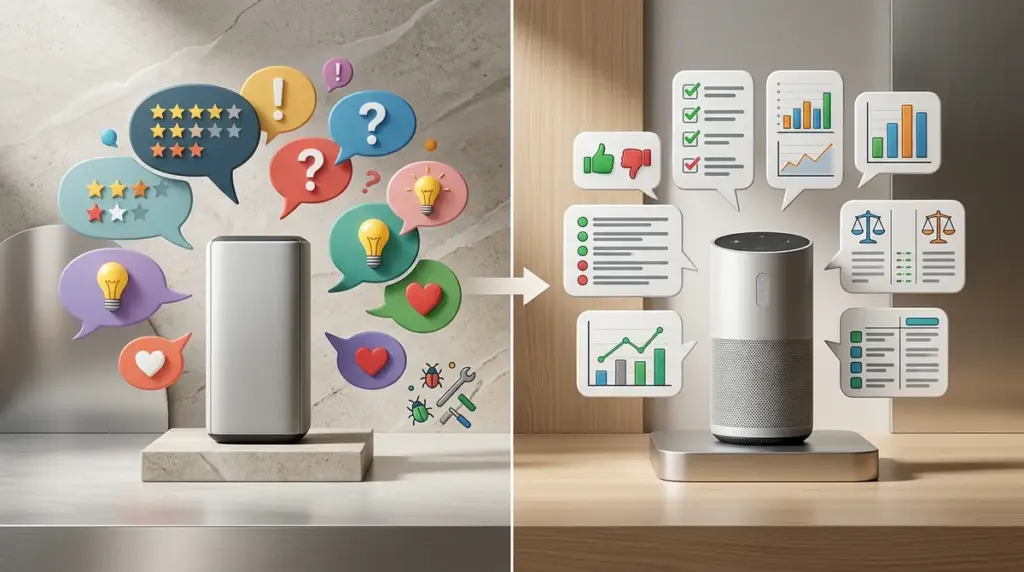
Buying decisions are rarely based on a single data point. When an SEO agency selects a new crawler or a publisher evaluates a CMS, they look at the aggregate sentiment. However, the linguistic nuance of a review changes significantly as a product moves from a disruptive startup to an established market leader. Understanding this shift is critical for buyers who need to separate "early adopter enthusiasm" from "enterprise-grade reliability."
A 4.5-star rating for a tool in its first year often signals innovation and high-touch support, whereas the same rating for a decade-old platform suggests stability and ecosystem integration. To make informed procurement decisions, you must decode the specific vocabulary used at each stage of the product lifecycle.
The Launch Phase: Aspirational Language and Feature Requests
In the earliest stages of a product, review language is dominated by potential. Users are often "early adopters" who are willing to overlook technical debt in exchange for a competitive edge or a lower price point. You will see words like game-changer, disruptive, and innovative used frequently. These early sentiments can be misleading, as launch hype distorts early reviews and overshadows potential flaws.
Best for: Identifying emerging trends and securing "lifetime" deals before price hikes.
Reviews at this stage are rarely about the current feature set; they are about the roadmap. The language is forgiving. A user might write, "The UI is a bit buggy, but the team is incredibly responsive." This indicates a high-touch customer success model that usually disappears as the company scales. If you are looking for a tool that you can help shape through feedback, these are the reviews to prioritize.
The "Boutique" Sentiment
Early reviews often mention the founders or specific support agents by name. This "boutique" sentiment is a hallmark of a maturing product that hasn't yet hit the friction of mass-market support tickets. When these names disappear from reviews and are replaced by "the support team" or "the help desk," it is a clear signal that the company has moved into its growth phase.
The Growth Phase: Comparison and Benchmarking
As a product gains traction, the language shifts from aspirational to comparative. Reviewers stop talking about what the tool could be and start measuring it against the incumbent market leaders. This is the most useful phase for SEO professionals and marketers to read reviews because the feedback is grounded in practical utility.
You will see phrases like:
- "Much faster than [Competitor X] for bulk exports."
- "A more affordable alternative to [Industry Standard]."
- "Missing the advanced API functionality found in [Enterprise Tool]."
The sentiment becomes more critical. The "honeymoon phase" ends, and users start demanding reliability. If a growth-stage product maintains high ratings while the review language shifts toward efficiency and workflow integration, it is a strong indicator of a sustainable product-market fit.
Pro Tip: When reading growth-stage reviews, ignore the 5-star and 1-star extremes. Focus on the 4-star reviews that list specific missing features. These are written by power users who understand the tool's limitations in a production environment.
Maturity: The Era of Stability and "Bloat"
When a product reaches maturity, the review language undergoes its final major transformation. The words reliable, standard, and essential become common. At this stage, the product is no longer exciting; it is a utility. However, this is also when the "bloat" complaints begin.
Long-term users who have been with the product for years may start to use language like clunky, dated UI, or overcomplicated. This happens because the product has added years of features to satisfy enterprise requirements, often at the expense of the streamlined experience that made it popular in the first place.
The Shift to Integration Language
In mature product reviews, the focus moves away from individual features and toward how well the tool plays with others. Reviewers will spend more time discussing native integrations, SSO capabilities, and permission management. For an agency lead, these reviews are more important than feature lists because they dictate how much "admin overhead" the tool will require.
Best for: Large-scale operations where uptime and cross-departmental compatibility are more important than the latest "shiny" feature.
How to Audit Review Recency and Relevance
Because language changes so much over time, a review from three years ago may as well be about a different product. For software-as-a-service (SaaS) especially, the codebase and the support structure can change entirely in 18 months. This is why long-term reviews matter more than initial impressions, especially for rapidly evolving products.
When evaluating a tool, filter reviews by "Most Recent" and look for the following linguistic red flags:
The "Legacy" Trap: If recent reviews use words like stagnant or slow to update, while older reviews are glowing, the product may be in a "harvest" phase where the parent company is extracting profit without reinvesting in development.
The "Scaling Pains" Signal: If recent reviews frequently mention unresponsive support or long ticket wait times, the company is likely struggling to scale its human operations to match its user growth. This is a common risk for tools that have recently gone through a Series B or C funding round.
Auditing Your Procurement Strategy Based on Product Age
To get the most value out of user feedback, you must adjust your weightings based on the product's maturity level. Do not treat all testimonials as equal. A mature product with a 4.2 rating is often a safer bet for an enterprise than a new product with a 4.9 rating, simply because the mature product has survived the "comparison" phase and is being judged by a much harsher, more professional user base.
When selecting your next tool, use this checklist to filter review content:
- For Startups: Look for "responsiveness" and "velocity of updates."
- For Growth Tools: Look for "value for money" and "comparative speed."
- For Mature Platforms: Look for "reliability," "integration depth," and "security."
Frequently Asked Questions
How do I know if a product is "mature" or just "old"?
Look at the integration list. A mature product will have deep, two-way integrations with other industry standards. An "old" product will have a long list of features but will lack modern API documentation or connectivity with newer tools in the stack.
Why do mature products often have lower average scores than startups?
Startups benefit from "survivorship bias" and a small, dedicated fan base. Mature products have thousands of users, including many who are forced to use the tool by their employer. This leads to more "grumble" reviews about UI preferences rather than actual functional failures.
Should I trust reviews that mention specific employees?
Only if they are recent. Mentioning employees by name is a sign of a high-touch, small-team environment. If you see this in reviews from 2021 but not in 2024, the company has likely moved to a tiered, automated support system.