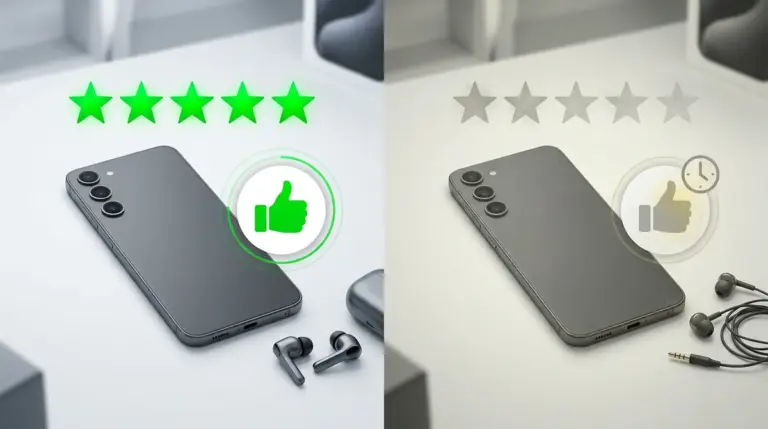
Modern e-commerce has shifted from a discovery-based model to a validation-based model. When a shopper lands on a product page, they are rarely looking for features—the marketing copy has already provided those. Instead, they are looking for reasons to disqualify the purchase. This "defense-first" mindset makes the review section the most critical real estate on any commercial domain. For SEOs and site owners, understanding the neurobiology of social proof is the difference between a high bounce rate and a high conversion rate.
The Mitigation of Perceived Risk and Loss Aversion
Psychologically, the pain of losing $100 is twice as intense as the joy of gaining $100. This concept, known as loss aversion, dictates almost every online transaction. When a shopper reads a review, they aren't just looking for quality; they are performing a risk assessment. They want to ensure the product won't break, the sizing isn't erratic, and the shipping won't take three weeks.
Best for: High-ticket items where the financial risk is significant and the "buyer's remorse" threshold is low.
By reading reviews first, shoppers outsource the "trial and error" phase of purchasing to someone else. They are looking for "edge cases"—the 1% of scenarios where the product fails—to see if those failures are deal-breakers for their specific needs. If a review mentions a specific flaw that the shopper can live with, the risk is effectively neutralized, moving them closer to the checkout.
Financial vs. Social Risk
Risk isn't always about money. In categories like fashion, tech, or professional services, there is a significant social risk. Will this laptop look out of place in a boardroom? Will this dress fit the "cocktail" description? Reviews provide the social validation that static product images cannot. They offer a window into the "lived experience" of the product, which is the ultimate currency in digital trust.
Heuristics and the Cognitive Shortcut
The "paradox of choice" suggests that too many options lead to decision paralysis. In a marketplace with 50 similar ergonomic chairs, the human brain cannot logically process 50 sets of technical specifications. Instead, it uses heuristics—mental shortcuts that allow for fast, efficient decision-making.
The star rating is the ultimate heuristic. It condenses hundreds of hours of collective user experience into a single visual data point. Shoppers read reviews first because it is the most energy-efficient way to filter out the noise. If a product has 4.8 stars across 2,000 reviews, the brain's "safety" filter is triggered, allowing the shopper to stop analyzing and start buying.
- Aggregation: Shoppers look for the volume of reviews to establish a statistical baseline.
- Recency: Older reviews are discounted; shoppers look for "current state" performance.
- Sentiment Consistency: If multiple reviews mention the same specific pro or con, the brain accepts it as an objective fact.
Pro Tip: Do not curate your reviews to show only 5-star ratings. Data shows that products with a 4.2 to 4.5 rating convert better than those with a perfect 5.0. Consumers perceive a perfect score as "manufactured" or "gamed," which triggers a skepticism response rather than a trust response.
The Negativity Bias and the Search for Authenticity
Humans are evolutionarily hardwired to pay more attention to negative information than positive information. In a survival context, ignoring a "good" berry is a missed meal, but ignoring a "bad" berry is fatal. In e-commerce, this manifests as the "negative review search."
Shoppers often skip the 5-star reviews entirely and head straight for the 1-star and 2-star feedback. They aren't necessarily looking for reasons not to buy; they are looking for the "worst-case scenario." If the 1-star reviews are about "slow shipping" but the shopper isn't in a rush, the negative review actually increases their confidence in the product's quality. This transparency creates a level of authenticity that polished marketing copy can never achieve.
Social Proof as a Survival Instinct
Social proof is the psychological phenomenon where people assume the actions of others in an attempt to reflect correct behavior for a given situation. In the wild, if you see a crowd running in one direction, you don't stop to ask why—you run. In digital commerce, a high volume of reviews signals that a product is "safe" because the "tribe" has already vetted it.
For agencies and publishers, this means that the placement of reviews is just as important as the content. Placing a "top-rated" badge or a review snippet above the fold leverages this instinct immediately, reducing the cognitive load required to stay on the page. It signals that the user is in the right place and that others have successfully navigated this path before them.
Maximizing Conversion Through Psychological Triggers
To leverage the psychology of reviews, site owners must move beyond simple star ratings. The way information is structured can either facilitate or hinder the shopper's mental shortcuts. Concrete details outperform vague praise every time.
Best for: Affiliate marketers and e-commerce managers looking to decrease cart abandonment rates.
Instead of just showing a rating, highlight "Verified Purchase" badges and allow users to filter reviews by specific attributes (e.g., "Fit," "Durability," "Ease of Setup"). This allows the shopper to find the specific "risk mitigation" data they need without scrolling through hundreds of irrelevant comments. When a shopper finds a review from someone with their exact problem or profile, the conversion is almost guaranteed.
Strategic Implementation of Review Data
To turn these psychological insights into revenue, publishers and SEOs should focus on the following deployment strategies:
1. Schema Markup: Ensure AggregateRating schema is implemented correctly. This pulls the "star heuristic" directly into the Search Engine Results Pages (SERPs), capturing the shopper's attention before they even click your link.
2. Review Mining for Copy: Read your customers' reviews to find the exact language they use. If shoppers consistently praise a specific feature using a specific phrase, move that phrase into your H2s and meta descriptions. You are essentially using their own psychological validation to attract new users.
3. Addressing the Negative: Respond to negative reviews publicly. This demonstrates brand accountability and mitigates the "fear of the unknown" for future shoppers. A brand that solves a problem in public is often more trusted than one that appears to have no problems at all.
FAQ
Why do shoppers trust strangers more than brand experts?
Shoppers perceive brand experts as having a financial bias. Strangers are viewed as peers with no vested interest in the transaction, making their "unfiltered" feedback more authentic and reliable in the eyes of the consumer.
What is the "tipping point" for review volume?
While it varies by industry, products with at least 20-50 reviews see a significant jump in conversion rates compared to those with fewer than 10. Beyond 50 reviews, the "wisdom of the crowd" effect takes over, and the incremental value of each new review begins to plateau.
Does the length of a review impact its psychological weight?
Yes. Mid-length reviews (200-500 characters) that provide specific context are more influential than one-word "Great!" reviews. Shoppers look for "narrative evidence" to support the star rating; without it, the rating feels unsubstantiated.
Should I delete old reviews if the product has been updated?
No. Instead, use a "Version 2.0" tag or a "Verified Update" response. Deleting reviews creates a "trust vacuum." Showing that you improved the product based on previous feedback is a powerful psychological trigger that demonstrates brand listening and evolution.