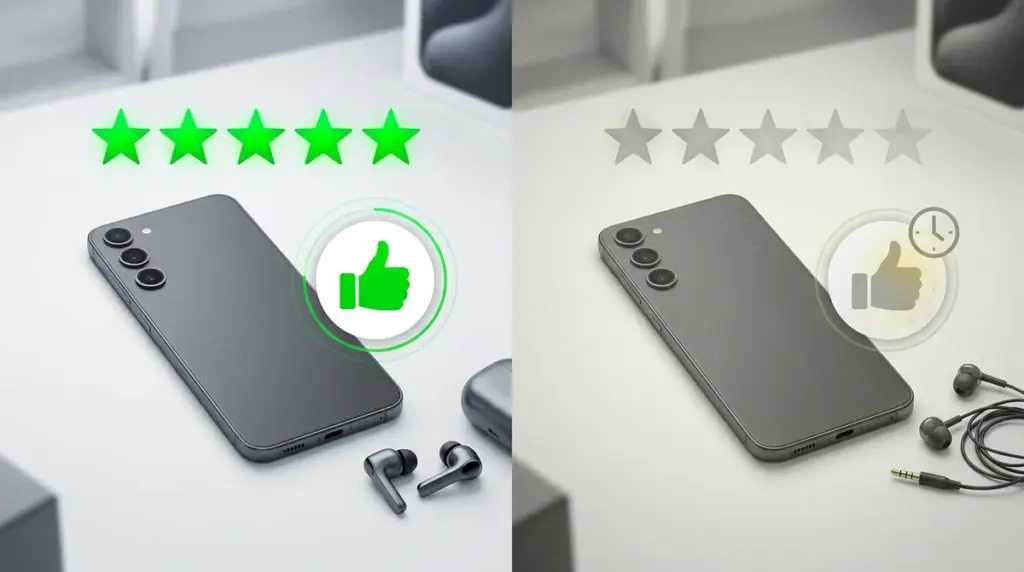
In high-velocity industries like SaaS, consumer electronics, and hospitality, the expiration date on consumer trust is shorter than ever. A five-star rating from eighteen months ago is functionally invisible to a modern buyer. When a prospect sees a "Best of" list or a product page where the most recent feedback is dated several quarters back, they don't see stability; they see a stagnant product or a business that has stopped engaging with its customers. In fast-moving categories, review recency is not a vanity metric—it is a primary conversion driver that dictates whether a lead stays on the page or bounces to a competitor with fresher social proof. Understanding the role of social proof in your customer journey is key to leveraging this effect, as how social proof impacts purchasing decisions can be a significant factor.
The Velocity of Trust in High-Churn Verticals
For industries defined by rapid iteration, such as MarTech or mobile hardware, the product reviewed six months ago often doesn't exist today. Software undergoes patches, UI overhauls, and pricing shifts. A review praising a specific integration is useless if that integration was deprecated in the last update.
Best for: Marketing managers in SaaS and e-commerce who need to justify the budget for automated review acquisition tools.
Data from consumer behavior studies consistently shows that 85% of consumers discount reviews older than three months. In categories like fashion or seasonal electronics, that window shrinks even further. If your review profile lacks "velocity"—the consistent cadence of new feedback—you are essentially forcing your prospects to gamble on whether your current service levels match your historical reputation.
Search Engine Sensitivity to Review Freshness
Search engines prioritize relevance, and in the context of local SEO and product snippets, relevance is inextricably linked to time. Google’s algorithms look for a steady stream of content to verify that a business is still active and providing a consistent level of service. A sudden halt in review activity can signal to an algorithm that a business has closed, changed ownership, or lost its market relevance.
Impact on Local Pack and Map Rankings
In local search, the "Review Snippet" often pulls the most recent relevant text. If your latest review mentions a specific dish or a specific service technician from last week, it provides a "freshness" signal that older, more generic reviews cannot match. This affects the click-through rate (CTR) from the search engine results page (SERP) directly. Users are conditioned to look for the "1 day ago" or "1 week ago" timestamp as a proxy for current quality.
The Psychological Weight of the Last 90 Days
When a user lands on a review profile, they rarely read the "Most Relevant" default view first. Instead, savvy buyers toggle to "Most Recent." They are looking for "the now." They want to know if the shipping delays mentioned in December were resolved by March. They want to know if the software bug reported in the previous version is still haunting the comments section.
- Recency as a Proxy for Reliability: Recent reviews prove the business is currently operational and successful.
- Contextual Accuracy: Latest feedback reflects the current version of the product, not a legacy iteration.
- Customer Support Benchmarking: Recent reviews often mention specific support interactions, giving prospects a real-time look at service quality.
Warning: Avoid "Review Spiking." Attempting to fix a recency problem by soliciting 50 reviews in a single week after months of silence triggers spam filters on major platforms. This behavior often leads to shadow-banning or the wholesale removal of the new reviews, as it mimics the pattern of fraudulent reputation management.
The Correlation Between Recency and Conversion Rates
Conversion rate optimization (CRO) is often treated as a design or copy problem, but it is frequently a social proof problem. A landing page featuring a testimonial from 2021 suggests the company is coasting on past glory. Conversely, a live feed of reviews from the last 30 days creates a sense of momentum. This is particularly critical for high-ticket items where the perceived risk of purchase is high. The buyer needs to know that people are buying—and enjoying—the product right now.
Strategic Management of Review Cadence
To maintain recency without triggering platform red flags, agencies and brand managers must move away from "campaign-based" solicitation and toward "trigger-based" automation. This involves integrating review requests into the post-purchase workflow so that feedback flows in at the same rate as sales. If your sales are consistent, your review growth should be consistent.
Key Differentiator: Unlike static testimonials, a dynamic review profile acts as a real-time FAQ. New reviewers often answer the questions that modern buyers are currently asking, such as compatibility with the latest OS or current shipping times during global logistics shifts.
Audit and Update Your Review Pipeline
To ensure your brand remains competitive in fast-moving categories, you must treat review recency as a recurring KPI rather than a one-time project. Stale feedback is a silent killer of conversion rates, especially when competitors are actively harvesting fresh sentiment. Start by auditing your current review velocity across your top three conversion channels. If the average age of your top five visible reviews exceeds 90 days, your social proof is likely working against you.
Implement a continuous feedback loop that incentivizes customers to share their experiences immediately after the "Aha!" moment of your product. This ensures that your public-facing reputation is always a reflection of your current best efforts, not a historical archive of who you used to be.
Frequently Asked Questions
How often should a business get new reviews to stay relevant?
In fast-moving categories like SaaS or retail, at least one to two new reviews per week are necessary to maintain a "fresh" appearance. For local services, two to three per month may suffice, provided they are high-quality and detailed.
Does Google prioritize recent reviews in search rankings?
Yes. Review recency is a known factor in local SEO. A consistent stream of new reviews signals to Google that the business is active and consistently satisfying customers, which can improve visibility in the Local Pack.
What is the "Review Decay" effect?
Review decay refers to the diminishing persuasive power of a review as it ages. As a review gets older, consumers view it as less representative of the current product or service, leading to lower trust and decreased conversion rates.