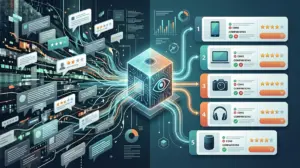
An opinion mining tool analyzes reviews, survey comments, support tickets, social posts, and other free-text feedback to detect sentiment, extract themes, and show what people actually like or dislike about a product or service. Buyers use it to compare software options quickly; teams use it to turn large volumes of comments into ratings trends, recurring pros and cons, and decision-ready insights.
What an opinion mining tool does
At a practical level, an opinion mining tool scans text and classifies opinion signals such as positive, negative, neutral, mixed, or emotion-based sentiment. Better tools go further by identifying entities and aspects inside the comment. Instead of only saying a review is negative, they can show that the reviewer liked ease of use but disliked pricing, onboarding, or support response time.
For comparison-led buying decisions, that matters more than a simple sentiment score. A strong tool helps you answer questions like:
- Which competitors get better feedback on support, reliability, or value?
- What complaints appear most often in 1-star and 2-star reviews?
- Which product features drive positive ratings and renewals?
- Are sentiment trends improving after a release, policy change, or service update?
Core outputs to expect
Most opinion mining platforms combine several outputs in one workflow:
- Sentiment scoring by comment, topic, product, or channel
- Aspect-based analysis for features such as price, usability, delivery, or customer support
- Keyword, phrase, and theme extraction
- Review summarization into common pros and cons
- Dashboards that track ratings, trends, and competitor comparisons
- Alerts for sudden spikes in negative feedback
When to use an opinion mining tool
Use one when manual review reading is too slow, inconsistent, or expensive. If you are comparing products with hundreds or thousands of reviews, a mining tool can surface patterns fast enough to support a shortlist. If you run a business, use it when feedback is spread across app stores, marketplaces, surveys, CRM notes, and social channels.
Best-fit use cases
An opinion mining tool is especially useful in these situations:
- Software evaluation: Compare SaaS products by recurring praise and complaints, not just star ratings.
- Voice of customer programs: Turn open-ended survey responses into trackable themes.
- Reputation monitoring: Spot service failures or delivery problems before ratings drop further.
- Product improvement: Prioritize fixes based on complaint frequency and severity.
- Competitive research: Benchmark your product against alternatives by feature-level sentiment.
When a basic sentiment tool is not enough
Simple sentiment scoring works for quick snapshots, but it often misses sarcasm, mixed opinions, and context. If your decision depends on understanding why people rate a product well or poorly, look for aspect-based sentiment, custom taxonomy support, and review-source segmentation. Those features make the output more actionable for buying and product decisions.
How to compare opinion mining tools
Not all tools are built for the same job. Some are lightweight review analyzers; others are enterprise voice-of-customer platforms with integrations, workflow automation, and advanced NLP. For fast comparison, focus on five buying criteria.
1. Accuracy on real review language
The best tool for your team is not the one with the broadest feature list; it is the one that handles your data well. Product reviews often contain slang, abbreviations, mixed sentiment, and category-specific terms. Test the tool on a sample of your own reviews and check whether it correctly identifies the topic and sentiment. A dashboard that looks polished is not useful if it mislabels common complaints.
2. Aspect and theme detection
If you need practical pros-and-cons analysis, aspect detection is essential. Look for tools that can separate feedback on pricing, setup, integrations, reliability, support, and performance. This is what turns raw text into side-by-side comparisons buyers can use.
3. Source coverage and integrations
Some tools are strongest on public reviews; others are better for internal feedback such as surveys, call transcripts, or help desk tickets. Choose based on where your decision-critical data lives. Useful integrations include CRM systems, support platforms, survey tools, spreadsheets, and BI dashboards.
4. Reporting for non-technical users
A commercially useful opinion mining tool should make findings easy to share. Look for filters by date, source, product, region, and rating band. Strong tools also provide clear exports, competitor comparison views, and summaries that can be used by product, support, and buying teams without analyst support.
5. Customization and governance
If you work in a regulated or complex category, custom dictionaries, topic rules, and approval workflows matter. They improve consistency and reduce the risk of misleading summaries. For enterprise buyers, permissions, audit trails, and data handling controls can be as important as sentiment accuracy.
Pros and cons of using an opinion mining tool
Pros
Opinion mining tools save time, reveal patterns humans miss, and make large review sets easier to compare. They are particularly strong when you need feature-level feedback, trend monitoring, and repeatable reporting across many products or vendors.
Cons
Results can be unreliable if the model is poorly tuned to your category. Short comments, sarcasm, multilingual content, and mixed opinions can reduce accuracy. Some tools also overpromise automation while still needing manual review for high-stakes decisions. In practice, the best setup combines automated analysis with spot checks by a human reviewer.
Short workflow example
A software buyer wants to compare three help desk platforms. They upload 2,000 public reviews and 300 internal notes from trial users. The tool groups feedback into themes such as setup, automation, reporting, integrations, and support. It then shows that Product A has the strongest sentiment on usability, Product B leads on reporting, and Product C gets the most complaints about onboarding delays. Instead of reading every review, the buyer uses the theme-level breakdown to shortlist two options for a live demo.
How to get better results from the tool
Use clean, segmented inputs
Separate public reviews, survey comments, and support tickets rather than mixing everything into one dataset. This makes comparisons clearer and prevents one noisy source from distorting the overall sentiment picture.
Define the comparison categories first
Before uploading data, decide which buying factors matter most: price, reliability, support, ease of use, implementation, or integrations. A tool is more useful when it reports against the criteria you actually use to choose between products.
Validate a sample manually
Review a small set of outputs by hand. If the tool consistently misreads a term or feature, adjust the taxonomy or rules before relying on the dashboard for decisions.
FAQ
Is an opinion mining tool the same as sentiment analysis software?
No. Sentiment analysis is usually one feature inside a broader opinion mining workflow. Opinion mining often includes theme extraction, aspect-level analysis, summarization, and comparison reporting.
Who should use an opinion mining tool?
It is useful for software buyers, product teams, customer experience teams, market researchers, and support leaders who need to compare large volumes of feedback quickly.
Can it replace reading reviews manually?
Not completely. It can reduce the amount of reading dramatically, but manual checks are still important for nuanced or high-impact decisions.
What is the most important feature to look for?
For most buyers, aspect-based sentiment is the key feature because it shows which specific product areas drive positive and negative reviews.