

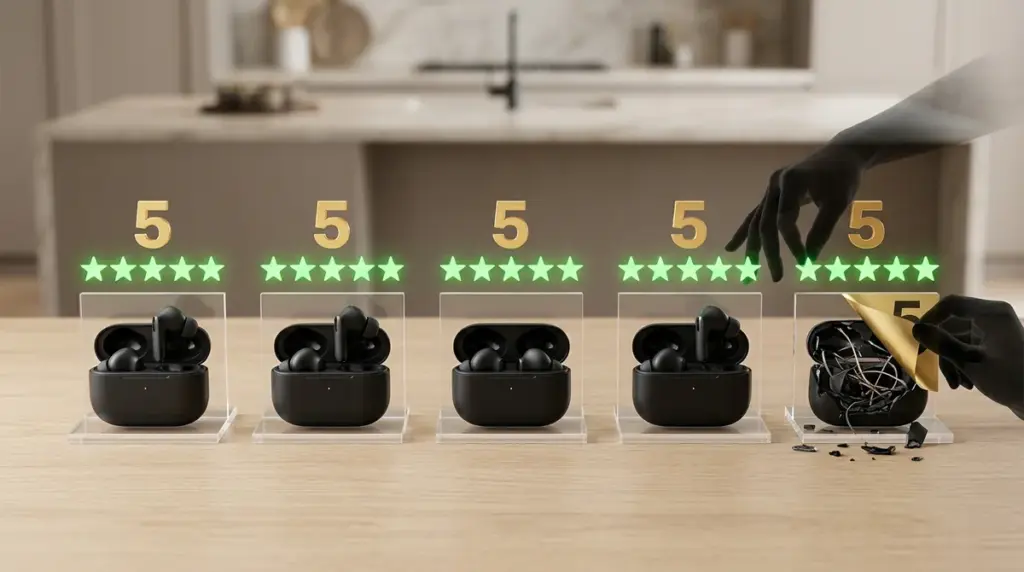
A high aggregate rating is often a vanity metric that hides a declining conversion rate. While a 4.8-star average looks impressive on a Google Search result or a landing page, savvy buyers no longer stop at the number. They look for the "trust gap"—the space between a high score and the actual substance of recent customer experiences. When a brand maintains a high score through legacy reviews while current service quality slips, the result is a sudden, unexplained drop in sales despite a "perfect" reputation. While a 4.8-star average looks impressive, savvy buyers no longer stop at the number, as they understand why two brands with similar scores can feel completely different.
The Recency Trap and Legacy Weighting
Most review platforms calculate averages based on the lifetime of the account. This mathematical reality creates a buffer that protects brands from the immediate impact of a service failure. If a company has 2,000 five-star reviews from 2020 to 2022, a string of fifty one-star reviews in 2024 will barely move the needle on the overall score. However, consumers filter by "Most Recent" as a default behavior.
Best for: Identifying operational decline before it hits the bottom line.
When the top three reviews on a profile are detailed complaints about shipping delays or poor support, the 4.9-star badge at the top of the page becomes a liability. It signals to the prospect that the brand is either coasting on past glory or, worse, manipulating its data. To maintain trust, the velocity of positive reviews must match the current volume of business. A "stale" high score is a red flag that suggests a business has stopped engaging with its customer base.
The Danger of Templated Responsiveness
Automation in reputation management is a double-edged sword. While responding to every review is a standard SEO recommendation, "bot-speak" destroys the human element of trust. If every negative review receives the exact same "We are sorry to hear about your experience, please contact support@Five Reviews" reply, the brand appears bureaucratic and dismissive.
Warning: Automated responses to negative feedback often provoke "review updates" where the customer edits their original 2-star review to a 1-star review, citing the robotic and unhelpful response as the reason.
Specific, concrete responses that address the actual complaint—mentioning specific product features, dates, or resolution steps—prove that there is a human behind the brand. A high score coupled with generic, repetitive replies suggests a company that is managing a metric rather than managing a customer relationship.
The 5.0 Paradox and the Search for Friction
Counter-intuitively, a perfect 5.0 rating often converts worse than a 4.5 to 4.8 rating. Modern shoppers are conditioned to look for "the catch." They actively seek out 3-star and 4-star reviews to find the realistic limitations of a product or service. If those middle-ground reviews are missing, the profile looks curated or "gated."
Why Review Gating Backfires
Review gating—the practice of only sending review invites to customers who have already indicated they are happy—is a short-term strategy with long-term consequences. This creates a skewed profile that lacks "constructive friction." Without a few honest critiques about minor issues, the glowing praise feels manufactured.
- Loss of Detail: Gated reviews tend to be short ("Great service!") which provides no SEO value or buyer insight.
- Platform Risk: Major review aggregators actively penalize or remove profiles found to be cherry-picking respondents.
- Expectation Mismatch: If a buyer only sees perfection, any minor flaw in their actual experience feels like a betrayal, leading to harsher negative reviews later.
Pro Tip: Use negative reviews as a feature, not a bug. A response that says, "Our software doesn't currently support X, but here is how our users work around that," builds more trust than a 5-star review that says nothing of substance.
The Content-to-Score Disconnect
Trust evaporates when the qualitative content of reviews contradicts the quantitative score. This often happens when brands use "incentivized reviews." A customer might leave a 5-star rating to receive a discount code, but their written comment might be lukewarm or even mention a flaw they are willing to overlook for the bribe.
Buyers look for specific nouns and verbs. They want to know if the "XL size fits like a Medium" or if the "SaaS implementation took six weeks instead of two." If the high score is supported only by vague adjectives like "amazing," "great," and "fast," the sophisticated buyer assumes the reviews are incentivized or fake. Authenticity is found in the details of the user's struggle and the brand's eventual solution.
Auditing Your Trust Velocity
To prevent trust erosion while maintaining high scores, brands must shift their focus from the aggregate number to the "Trust Velocity"—the rate at which authentic, detailed, and recent stories are being told about the brand. This requires a move away from passive reputation management toward active, transparent engagement. This requires a move away from passive reputation management toward active transparent engagement, showing trust is built in small public moments, not big campaigns.
Best for: Marketing managers who need to justify a shift in customer service resources.
Instead of hiding flaws, highlight the resolution. A brand that turns a 1-star situation into a public 4-star resolution through transparent communication will always out-convert a brand with a "perfect" but silent 5.0 profile. The goal is not to have a perfect score; the goal is to have a believable one.
Actionable Steps to Align Scores with Trust
If your conversion rates are falling despite a high review score, the following audit steps are required to diagnose the disconnect:
1. Check the "Review Gap": Compare your average score from the last 90 days against your lifetime average. If the delta is more than 0.5 points, your brand is in a trust crisis that the aggregate score is masking.
2. Analyze the "Word Count Trend": Are your recent reviews getting shorter? A drop in word count usually indicates a drop in customer passion or an increase in low-quality incentivized feedback.
3. Audit Response Personalization: Ensure that at least 50% of responses to 3-star reviews and below contain specific references to the customer's unique issue. Eliminate "Contact us at this email" as the first and only sentence.
4. Diversify Review Sources: If your high score is only on one platform but your Google Business Profile or Trustpilot is lagging, buyers will find the discrepancy. Trust is built through consistency across the entire digital ecosystem.
Frequently Asked Questions
Why is my 4.9-star rating not resulting in sales?
This usually happens because of "recency bias." If your most recent reviews are negative or several months old, buyers prioritize that information over the high aggregate score. They assume the business has changed for the worse since the high scores were earned.
Is it better to have a 4.7 rating than a 5.0?
Statistically, yes. Most consumer studies show that products with a 4.2 to 4.7 rating have higher conversion rates than those with a perfect 5.0, as the latter is often perceived as too good to be true or manipulated.
How should I handle a string of negative reviews if I want to keep my score high?
Do not try to bury them with fake positives. Instead, respond publicly and resolve the issues. A resolved negative review often carries more weight with a prospective buyer than a standard positive one because it demonstrates your post-purchase support quality.